
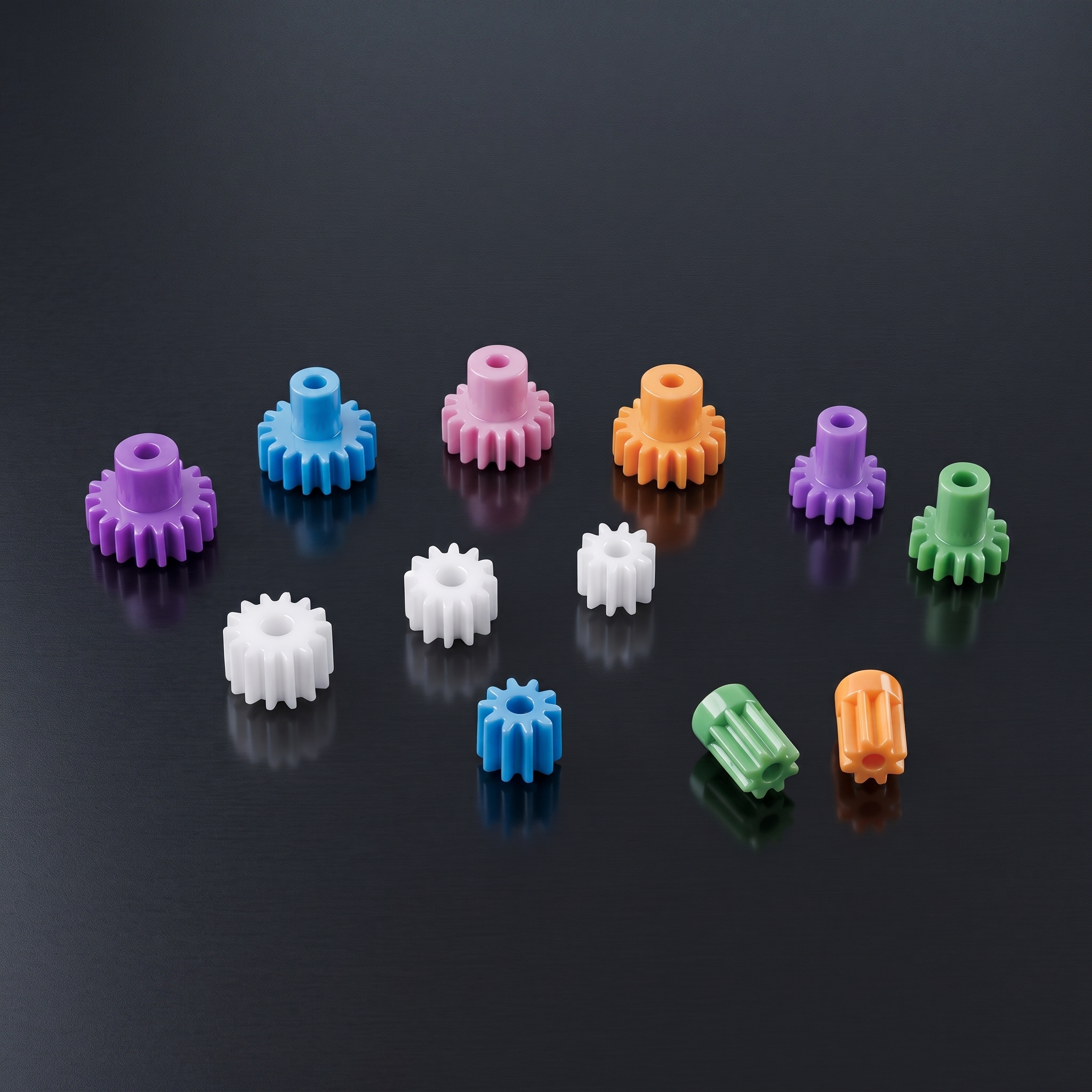
Precision Motor Pinion & Shaft Gears
pt_003
Specifications
- Product Category: Precision Transmission Components
- Tooth Profiles: Spur / Helical configurations
- Module Range: M0.2 to M1.5 (Micro to standard module tooling)
- Standard Materials: Wear-resistant POM (Polyoxymethylene / Acetal), Engineering Nylon (PA66 / PA46 / Glass-filled PA)
- Mounting Types: Press-fit interference bore, D-bore, splined bore, metal insert molding (brass/steel inserts)
- Primary Functions: Primary high-speed power input, rotational speed reduction, high-efficiency torque transfer
- Custom Capabilities: Precision bore tolerance control tailored for motor shaft diameters from Φ0.8mm to Φ5.0mm on DC, stepper, and brushless motors
- Applications: Micro DC & Stepper Motors, Brushless Motor Drivetrains, Power Tools, Smart Home Actuators, Drone Gimbals, Optical Zoom/Focus Mechanisms
Manufacturing Processes & Capabilities
- Micro-Module Tooling & High-Speed Profile Optimization: Covers M0.2 to M1.5 modules tailored for high-RPM operation; micro-tolerance tooling ensures precise tip/root reliefs, low pitch-circle runout, and consistent tooth geometry for smooth, high-speed meshing.
- Micron-Level Bore Tolerancing & Insert Molding: Press-fit motor bores are molded with micron-level tolerances to guarantee consistent, reliable pull-out torque; offers metal insert overmolding to prevent shaft slippage under dynamic torque spikes.
Features & Advantages
- High-RPM Stability & Centrifugal Resistance: Molded from high-crystallinity POM and resilient engineering nylon to maintain dynamic balance and structural integrity under 10,000–30,000+ RPM without thermal deformation or loosening.
- Whisper-Quiet Transmission & Low Vibration: Spur profiles maximize mechanical transmission efficiency, while helical teeth provide progressive engagement to eliminate high-frequency gear whine at high motor speeds.
- Self-Lubricating, Wear-Resistant & Long Service Life: Low-friction polymer materials provide continuous self-lubrication and fatigue endurance, minimizing tooth wear during continuous high-speed operation.
About Plastic Gears
A gear is a toothed wheel designed to transmit force to another gear or toothed component. The teeth of a gear can be shaped to minimize wear, vibration and noise, and to maximize the efficiency of power transmission.
Gears of differing size are often used in pairs for a mechanical advantage, allowing the torque of the driving gear to produce a larger torque in the driven gear at lower speed, or a smaller torque at higher speed.
The Advantages of Plastic Gears:
- Plastic gears are easily molded into various shapes, so they have a wider range of configurations.
- Plastic gears are less expensive and lighter in weight.
- Plastic gears are chemical- and corrosion-resistant.
- Plastic gears provide quieter and smoother operation and offer more efficient drive geometry.
- Plastic gears are inherently self-lubricating.
While plastic gears offer many advantages over metal gears, their effective use requires proper design and engineering to account for possible dimensional and property variations over the expected range of operating conditions.